- Pagina iniziale /
- Libri /
- Engineering & Transportation /
- Engineering /
- Electrical & Electronics /
- Elettronica /
- Sensors /
- Autonomous Vehicle Lidar: A Tutorial
0 ratings

Articolo #:
41474947
Autonomous Vehicle Lidar: A Tutorial
Articolo #:
41474947
ALL 3554
Dettagli del prezzo
Excluding Shipping & Custom charges ( Shipping and custom charges will be calculated on checkout )
*All items will import from Stati Uniti
0 ratings
Scrivi una recensione
Disponibile
 Importato dal negozio USA
Qtà:
Ordina subito e ricevilo entro Mercoledì, Agosto 05
Transazione sicura
Ubuy works hard to protect your security and privacy. Our advanced payment security system ensures confidentiality by encrypting your information during transmission using AES (Advanced Encryption Standards) and SSL (Secure Socket Layer) protocols. Your payment details are 100% secure as we do not share your payment details with third party sellers.
I nostri principali partner logistici


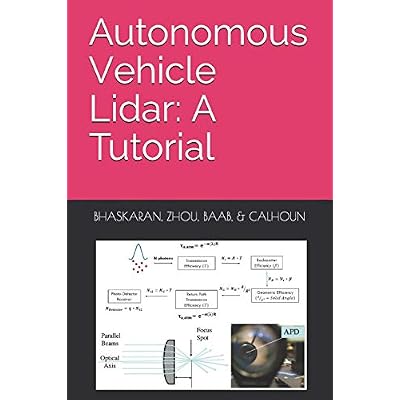
This tutorial text aims to introduce a technical but nonspecialist reader to autonomous vehicle lidar, starting from the fundamental physics of lidar and motivation for its application to autonomous vehicle systems.

Consegna
veloce

Reso
gratuito*

Imballaggio sicuro

Prodotti originali al 100%

Conformità PCI DSS

Certificazione ISO 27001


Note: Step Down Voltage Transformer required for using electronics products of Stati Uniti store (110-120). Recommended power converters Acquista ora.


Cosa salta all'occhio
Enhanced Accuracy
Offers precise environmental mapping using advanced laser technology, ensuring reliable navigation and obstacle detection, which significantly improves safety in autonomous vehicles.
Real-time Processing
Processes data instantly to allow vehicles to adapt to changing surroundings, enabling immediate responses to dynamic driving conditions and enhancing overall driving intelligence.
User-friendly Interface
Designed with accessibility in mind, providing intuitive controls and clear visualizations for developers, making it simpler to integrate and operate within autonomous systems.
Dettagli del prodotto
| Item Weight | 1.5 lbs (680 grams) |
A chi è consigliato?

-
Engineering Students
Students pursuing degrees in engineering can gain foundational knowledge on LIDAR technology used in autonomous vehicles.
-
Industry Professionals
Professionals in automotive and robotics sectors can enhance their understanding of LIDAR applications and integration techniques.
-
Hobbyist Developers
Independent developers and hobbyists interested in DIY autonomous projects will find useful insights and practical examples in this tutorial.

-
General Consumers
Everyday consumers seeking basic information about autonomous vehicles may find this tutorial overly technical and complex.
DESCRIZIONE DEL PRODOTTO
Autonomous Vehicle Lidar: A Tutorial
Hai qualche domanda? chatta con noi
Domande e risposte dei clienti
-
Domanda:
What is Lidar and how does it work in autonomous vehicles?
Risposta: Lidar, which stands for Light Detection and Ranging, is a technology that uses laser light to measure distances. In autonomous vehicles, Lidar systems emit pulses of laser light and measure the time it takes for the light to reflect off objects and return. This process creates a precise 3D map of the vehicle's surroundings, allowing it to detect obstacles, lane markings, and other vital features necessary for safe navigation. -
Domanda:
What are the key benefits of using Lidar in autonomous vehicles?
Risposta: The main benefits of Lidar include high precision, long-range detection, and the ability to create detailed 3D representations of the environment. This accuracy enables autonomous vehicles to make informed decisions in real time, enhancing safety and efficiency. Additionally, Lidar can operate effectively in various lighting conditions, unlike traditional cameras that may struggle at night or in bright sunlight. -
Domanda:
How does Lidar compare to other sensors used in autonomous vehicles?
Risposta: Lidar offers distinct advantages over other sensors like radar and cameras, particularly in terms of spatial resolution and object detection capabilities. Unlike cameras, Lidar collects accurate distance information, which is crucial for identifying and categorizing objects. Radar, while robust in detecting objects, lacks the fine detail that Lidar provides, thus making Lidar a preferred choice for comprehensive environmental mapping. -
Domanda:
Can Lidar systems be affected by weather conditions?
Risposta: Yes, Lidar systems can be impacted by adverse weather conditions, especially heavy rain, fog, or snow. These conditions can scatter the laser light, reducing detection accuracy. However, advancements in Lidar technology are continually being developed to enhance performance in less than optimal weather scenarios, making systems more reliable in various environments, ultimately improving safety for autonomous driving. -
Domanda:
What types of Lidar systems are commonly used in autonomous vehicles?
Risposta: There are two primary types of Lidar systems: solid-state Lidar and mechanical Lidar. Solid-state Lidar uses electronic components to scan the environment, offering simpler, more compact designs with reduced moving parts. Mechanical Lidar, on the other hand, employs rotating mirrors or similar technology to achieve a complete field of view. Each type has its advantages, so manufacturers select based on specific applications and desired performance characteristics. -
Domanda:
What role does Lidar play in the development of self-driving cars?
Risposta: Lidar plays a critical role in the development of self-driving cars by enabling these vehicles to perceive their surroundings accurately. This capability is crucial for tasks like obstacle detection, lane keeping, and navigation. Manufacturers rely on the data generated by Lidar systems to refine their algorithms and improve the overall efficiency and safety of autonomous driving technologies, ensuring a seamless driving experience. -
Domanda:
How is data from Lidar processed for vehicle navigation?
Risposta: Data from Lidar is processed using sophisticated algorithms that analyze the 3D point clouds generated. This involves filtering noise, identifying objects, and determining distances. The processed data is then integrated with information from other sensors, such as cameras and radar, to create a cohesive understanding of the vehicle's environment. This integration allows autos to navigate safely and efficiently through various driving conditions. -
Domanda:
What are the limitations of Lidar technology in autonomous driving?
Risposta: While Lidar is robust, it does have limitations. Its effectiveness can decrease in certain weather conditions, and it may struggle to recognize certain materials or objects that do not reflect laser light effectively. Additionally, there is a significant cost associated with high-quality Lidar systems, which can be a barrier to widespread adoption in lower-cost vehicle models. Despite these challenges, ongoing research continues to enhance Lidar technology. -
Domanda:
Can Lidar be integrated with other technologies for enhanced vehicle performance?
Risposta: Yes, integrating Lidar with other technologies like cameras, radar, and artificial intelligence (AI) enhances overall vehicle performance. This fusion of data allows for a more comprehensive perception of the environment, addressing the individual limitations of each technology. Such integration is essential to the advancement of autonomous systems, enabling vehicles to make informed decisions during complex driving scenarios. -
Domanda:
Where can I buy Autonomous Vehicle Lidar: A Tutorial in Albania?
Risposta: You can purchase Autonomous Vehicle Lidar: A Tutorial at Ubuy. They offer a wide selection of educational and technical resources, ensuring you can find the right materials for your needs. Ubuy stands out for its user-friendly platform and reliable customer service, making it a preferred option for acquiring specialized items in your Albania.
Sensors Editorial Review
Nessuna recensione editoriale trovata
Recensioni e valutazioni dei clienti
1 valutazioni dei clienti
-
5 stella
100%
-
4 stella
0%
-
3 stella
0%
-
2 stella
0%
-
1 stella
0%
Recensisci questo prodotto
Condividi le tue impressioni con altri clienti
Affidabilità della piattaforma e fiducia degli acquirenti

MA
Mohammad
Acquirente verificato
“Excellent quality and original too,when ubuy send original things I will appreciate that ,I very satisfied thank you”
23 July 2026 · via Trustpilot
CK
Chitra
Acquirente verificato
“The order and delivery progress was communicated very well. Package arrived within the estimated time. Products arrived as expected in good condition.”
22-Jul-26 · via Trustpilot
K
kund
Acquirente verificato
“Good supply of products. Safe payment methods, and shipment worldwide! Genuine products.”
23-Jul-26 · via Trustpilot
OO
Onesi
Acquirente verificato
“Was my first time buying a product from Ubuy, but I found it so helpful. This is reliable. Gonna place a new order!”
22 July 2026 · via Trustpilot
SJ
SAO JOHN
Acquirente verificato
“Ubuy is a great online platform to buy stuff. Reliable, fast delivery time and great value for money. I've been using Ubuy online shopping platform for three years now and will continue to do so.”
23 July 2026 · via Trustpilot
Pagamento sicuro
Consegna in tutto il mondo
Resi facili
Prodotti originali
Cronologia dei prezzi del prodotto
Informazioni importanti
- Limitazioni: per i prodotti spediti a livello internazionale, si prega di notare che ogni garanzia del produttore potrebbe non essere valida, le opzioni di assistenza del produttore potrebbero non essere disponibili, i manuali del prodotto, le istruzioni e gli avvisi di sicurezza potrebbero non essere nella lingua del paese di destinazione. I prodotti (e i materiali di accompagnamento) potrebbero non essere progettati in conformità con gli standard, le specifiche e i requisiti di etichettatura del paese di destinazione e i prodotti potrebbero non essere conformi alla tensione di rete del paese di destinazione e ad altri standard elettrici (richiedendo l'uso di un adattatore o di un trasformatore, se necessario). Il destinatario è responsabile di assicurare che il prodotto possa essere legalmente importato nel paese di destinazione. Quando si ordina da Ubuy o dai suoi affiliati, il destinatario è l'importatore registrato ed è tenuto a rispettare tutte le leggi e i regolamenti del paese di destinazione.
- Non tutti i prodotti elencati su Ubuy sono in vendita, poiché Ubuy è un motore di ricerca globale. I prodotti sono soggetti a regolamenti di esportazione/commercio.
ALL 3554
Ordina subito e ricevilo entro Mercoledì, Agosto 05
Questo articolo non è vietato nel mio Paese. (Se l'articolo non è vietato nel tuo Paese, fai clic sul link: il nostro team verificherà l'autorizzazione.)
Qtà:
Transazione sicura
Conforme allo standard PCI DSS e certificato ISO 27001:2022, con pagamenti crittografati e piena protezione dell'acquirente su ogni ordine.
I nostri principali partner logistici
La consegna transfrontaliera più rapida
Caratteristiche e benefici
- Comprehensive introduction to autonomous vehicle lidar.
- Covers fundamental physics and applications of lidar technology.
- Explores time of flight design concepts in detail.
- Discusses beam steering and timing methods.
- Designed for both technical readers and non-specialists.
- Prepares readers for laboratory explorations in the field.
Garanzia Ubuy
Vivi un'esperienza di shopping senza pensieri con prodotti 100% originali, sicurezza dei pagamenti conforme allo standard PCI DSS, protezione dei dati certificata ISO 27001, la consegna internazionale più rapida, resi gratuiti, e imballaggio sicuro su ogni ordine.*